Name the Highest Form of the Art of Dance Quizlet

Ballet is a formalized class of dance with its origins in the Italian Renaissance courts of 15th and 16th centuries. Ballet spread from Italian republic to France with the help of Catherine de' Medici, where ballet developed even further under her aristocratic influence. An early on example of Catherine's development of ballet is through 'Le Paradis d' Amour', a slice of piece of work presented at her daughter'due south wedding, Marguerite de Valois to Henry of Navarre. Aristocratic coin was responsible for the initial stages of development in 'courtroom ballet', as it was royal money that dictated the ideas, literature and music used in ballets that were created to primarily entertain the aristocrats of the time. The beginning formal 'court ballet' ever recognized was staged in 1573, 'Ballet des Polonais'. In true class of purple amusement, 'Ballet des Polonais' was commissioned by Catherine de' Medici to accolade the Smoothen ambassadors who were visiting Paris upon the accretion of Henry of Anjou to the throne of Poland. In 1581, Catherine de' Medici deputed another courtroom ballet, Ballet Comique de la Reine, all the same information technology was her compatriot, Balthasar de Beaujoyeulx, who organized the ballet. Catherine de' Medici and Balthasar de Beaujoyeulx were responsible for presenting the first court ballet ever to use the principles of Baif'due south Academie, past integrating poetry, trip the light fantastic toe, music and set up design to convey a unified dramatic storyline. Moreover, the early organization and evolution of 'court ballet' was funded by, influenced by and produced by the aristocrats of the time, fulfilling both their personal entertainment and political propaganda needs.
In the belatedly 17th century Louis 14 founded the Académie Royale de Musique (the Paris Opera) within which emerged the first professional person theatrical ballet company, the Paris Opera Ballet. The predominance of French in the vocabulary of ballet reflects this history. Theatrical ballet soon became an independent class of fine art, although however ofttimes maintaining a close association with opera, and spread from the heart of Europe to other nations. The Royal Danish Ballet and the Imperial Ballet of the Russian Empire were founded in the 1740s and began to flourish, especially after nearly 1850. In 1907 the Russian ballet in turn moved back to France, where the Ballets Russes of Sergei Diaghilev and its successors were especially influential. Soon ballet spread around the world with the formation of new companies, including London'south The Majestic Ballet (1931), the San Francisco Ballet (1933), American Ballet Theatre (1937), the Royal Winnipeg Ballet (1939), The Australian Ballet (1940 as the predecessor Borovansky Ballet), the New York City Ballet (1948), the National Ballet of Canada (1951), and the National Ballet Academy and Trust of India (2002).[one]
In the 20th century styles of ballet continued to develop and strongly influence broader concert dance, for instance, in the U.s. choreographer George Balanchine developed what is now known as neoclassical ballet, subsequent developments take included contemporary ballet and mail-structural ballet, for example seen in the work of William Forsythe in Germany.
The etymology of the word "ballet" reflects its history. The word ballet comes from French and was borrowed into English effectually the 17th century. The French give-and-take in plow has its origins in Italian balletto, a diminutive of ballo (trip the light fantastic). Ballet ultimately traces back to Italian ballare, meaning "to trip the light fantastic toe".[ii]
Origins [edit]
Renaissance – Italian republic and France [edit]
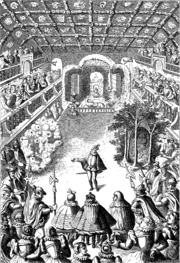
Ballet originated in the Renaissance courtroom as an outgrowth of court pageantry in Italy,[3] where aristocratic weddings were lavish celebrations. Tutus, ballet slippers and pointe work were not withal used. The choreography was adapted from court dance steps.[four] Performers dressed in fashions of the times. For women that meant formal gowns that covered their legs to the ankle.[5] Early ballet was participatory, with the audience joining the dance towards the end.
Domenico da Piacenza (c. 1400–c. 1470) was 1 of the beginning dancing masters. Along with his students, Antonio Cornazzano and Guglielmo Ebreo da Pesaro, he was trained in dance and responsible for teaching nobles the art. Da Piacenza left one work: De arte saltandi et choreus ducendi (On the art of dancing and conducting dances), which was put together past his students.[vi]
In 1489, Galeazzo, Knuckles of Milan, married Isabella of Aragon in Tortona. An elaborate dance entertainment was arranged for the celebrations by the Italian dance chief Bergonzio di Botta. The dances were linked by a slim narrative concerning Jason and the Argonauts, and each corresponded to a different course for the dinner. Tristano Calco of Milan wrote almost the event, and it was considered so impressive, that many similar spectacles were organized elsewhere.[7] [8]
Ballet was further shaped by the French ballet de cour, which consisted of social dances performed by the nobility in tandem with music, speech, verse, vocal, pageant, decor and costume.[9] When Catherine de' Medici, an Italian aristocrat with an interest in the arts, married the French crown heir Henry II, she brought her enthusiasm for dance to France and provided financial support. Catherine's glittering entertainments supported the aims of court politics and ordinarily were organized around mythological themes.[ten] The showtime ballet de cour was the Ballet de Polonais. This Ballet was performed in 1573 on the occasion of the visit of the Polish Administrator. It was choreographed past Balthasar de Beaujoyeulx and featured an hour-long dance for sixteen women, each representing a French province. Ballet Comique de la Reine (1581), which was also choreographed and directed by Balthasar de Beaujoyeulx, was commissioned by Louise of Lorraine, queen consort of King Henry Three, son of Catherine, to gloat the marriage of Henry's favorite the Duke de Joyeuse to Marguerite de Lorraine, the sis of Queen Louise. The ballet lasted for more than than five hours and was danced past twenty-four dancers: twelve naiades and twelve pages.[11] [12]
In the aforementioned year, the publication of Fabritio Caroso's Il Ballarino, a technical manual on courtroom dancing, both functioning and social, helped to establish Italy as a center of technical ballet evolution.[13]
17th century – France and Courtroom Dance [edit]

Ballet developed as a performance-focused art form in France during the reign of Louis Fourteen, who was passionate about trip the light fantastic.[14] His involvement in ballet dancing was politically motivated. He established strict social etiquettes through dancing and turned it into one of the near crucial elements in courtroom social life, finer holding authority over the nobles and reigning over the land.[15] Louis's initiates led to the refinery and perfection of social dancing among aristocrats equally a way to display royalty, further consolidating the art of classical ballet with newly established rules and protocols.[16]
In 1661 Louis Xiv, adamant to further his ambition in controlling the nobles [17] and reverse a pass up in dance standards that began in the 17th century, established the Académie Royale de Danse.[14] Before that, aristocrats considered dancing, together with riding and military training as 3 major disciplines in showcasing their nobility. However, Louis' founding of the Academy diverted their attention from military arts to court social functions, from state of war to ballet, further tightening rules around them.[eighteen]
To aggrandize the influence of French culture throughout Europe, Louis ordered Pierre Beauchamp, the male monarch's personal dance teacher and favorite partner in ballet de cour in the 1650s,[xix] to create "a way of making trip the light fantastic understood on newspaper".[twenty] Beauchamp was as well appointed Intendant des ballets du roi and in 1680 became the manager of the dance university, a position he held until 1687.[19] This lodge led to an intense research in this area by many ballet masters, however, only Beauchamp's trip the light fantastic toe note system got recognized.[21] In his arrangement, he codified the 5 basic positions of the feet in ballet.[19] Raoul Auger Feuillet, a Parisian ballet master, subsequently adopted his system and had his work published in 1700. His notation organization became significantly popular in Europe.[22]
Feuillet concentrated his efforts on the near influencing dance at court, chosen "La belle danse", or as well known equally "The French noble manner". This kind of dance was popular at balls or courts with more than enervating skills. "Entrée grave", as one of la belle danse's highest form, was typically performed by one man or two men with graceful and dignified movements, followed by tiresome and elegant music. At this time, information technology'southward only men that performed la belle danse and entrée grave. Women did perform at queen's ballets and other social occasions, only not at entrée grave, rex'south ballets, at courts or on Paris' stages, non until 1680s. During this particular time, men were considered to exist the champion and chief of art, displaying their masculine, dignified and noble dance, a rex'south trip the light fantastic. This too fix the model for classical ballet.[23]
Courtroom ballets had a long history of combining dance and etiquette since the Renaissance, but when it came to la belle danse, etiquettes in ballet were brought to a completely new height. Every unmarried etiquette rule in Louis' courts was put in great detail in la belle danse and 1 could certainly see others' noble status through their dances.[24] 5 positions of the bodies codification by Beauchamp, followed by Feuillet, described the body similar a miniature court, with the head every bit the cardinal point, coordinating its limbs like the male monarch ruling his state. A dancer performing a genuine noble would perform dissimilar five positions than i performing a peasant or lower-ranking characters.[25] Proof of nobility was also indicated through apply of masks, makeup, costumes especially shoes in la belle danse.[26]
Jean-Baptiste Lully, an Italian violinist, dancer, choreographer, and composer, who joined the court of Louis Xiv in 1652,[27] played a significant role in establishing the full general direction ballet would follow for the next century. Supported and admired by King Louis XIV, Lully oftentimes bandage the king in his ballets. The title of Sun King for the French monarch, originated in Louis XIV'south part in Lully'southward Ballet de la Nuit (1653). The 14-year-old Louis Fourteen danced five roles in this 12-hour ballet.[28] This Ballet was lavish and featured a scene where a set piece of a house was burned downwards, included witches, werewolves, gypsies, shepherds, thieves, and the goddesses Venus and Diana.[29] The ballet's main theme was not darkness and night terrors though, simply its focus was on Louis who appeared at the end as the Dominicus (the Sun God, Apollo), putting an end to the dark.[30] Lully'due south principal contribution to ballet were his nuanced compositions. His agreement of movement and dance allowed him to compose specifically for ballet, with musical phrasings that complemented physical movements.[29] Lully too collaborated with the French playwright Molière. Together, they took an Italian theatre manner, the commedia dell'arte, and adjusted it into their work for a French audition, creating the comédie-ballet. Among their greatest productions, with Beauchamp equally the choreographer,[19] was Le Bourgeois Gentilhomme (1670).[31]
In 1669 Louis Xiv founded the Académie d'Opéra with Pierre Perrin as managing director.[32] Louis 14 retired as a dancer in 1670, largely because of excessive weight gain. Earlier, in 1661 he had founded a schoolhouse, the Adacemie Royale de danse. Beauchamp was the first ballet-main of the Opéra and created the dances for the new company'due south first production Pomone with music by Robert Cambert.[19] Later, afterwards Perrin went broke, the king reestablished the Opéra equally the Académie royale de Musique and fabricated Lully the director.[32] Beauchamp was one of the principal choreographers.[19] In this position Lully, with his librettist Philippe Quinault, created a new genre, the tragédie en musique, each act of which featured a divertissement that was a miniature ballet scene.[27] With almost all his important creations Jean-Baptiste Lully brought together music and drama with Italian and French dance elements. His work created a legacy which would define the future of ballet.
Popularity throughout Europe [edit]

The Purple Ballet of the Dowager of Bilbao's Grand Brawl, 1626.
France'south court was in some means the leading source of fashionable civilization for many other purple courts in Europe. Styles of amusement were imitated, including the imperial ballets. Courts in Kingdom of spain, Portugal, Poland, Federal republic of germany, and elsewhere all became audiences and participants in ballets. In addition to France, Italy became an important influence on the art form, predominantly Venice.
Professional ballet troupes began to organize and tour Europe, performing for aristocratic audiences. In Poland, Rex Władysław IV Vasa (1633–1648) hosted Italian opera productions, which included ballet performers in some scenes. The famous European ballet-masters who worked for the Smoothen court include Jean Favier, Antoine Pitrot, Antonio Sacco and Francesco Caselli.[33]
18th century [edit]
French republic and evolution as an art form [edit]
The 18th century was a period of advancement in the technical standards of ballet and the menstruation when ballet became a serious dramatic art form on par with the opera. Central to this advance was the seminal work of Jean-Georges Noverre, Lettres sur la danse et les ballets (1760), which focused on developing the ballet d'action, in which the movements of the dancers are designed to express character and help in the narrative. Noverre believed that: ballet should be technical but as well move the audience emotionally, plots demand to be unified, the scenery and music demand to back up the plot and be unified within the story, and that pantomime needs to be elementary and understandable.[34]
Reforms were made in ballet composition past composers such as Christoph Willibald Gluck. Finally, ballet was divided into 3 formal techniques sérieux, demi-caractère and comique. Ballet also began to be featured in operas as interludes called divertissements.
Exterior France [edit]
Venice continued to be a centre of trip the light fantastic toe in Europe, particularly during the Venice Carnival, when dancers and visitors from across the continent would travel to the city for a lively cultural exchange. The metropolis'due south Teatro San Benedetto became a famous landmark largely due to the ballets performed in that location. Italian ballet techniques remained the dominant influence in much of southern and eastern Europe until Russian techniques supplanted them in the early on 20th century.
Ballet performances spread to Eastern Europe during the 18th century, into areas such as Hungary, where they were held in private theatres at aristocratic castles. Professional companies were established that performed throughout Hungary and also toured abroad. The Budapest National Theatre increasingly serving a role as a home for the dancers.[35]
Some of the leading dancers of the fourth dimension who performed throughout Europe were Louis Dupré, Charles Le Picque with Anna Binetti, Gaetano Vestris, and Jean-Georges Noverre.[33]
19th century [edit]

Polish ballet performers at the 1827 Venice Funfair. The dancer on the left is performing "en travestie" as a woman taking the human being'south role.
The ballerina became the most popular trip the light fantastic performer in Europe in the starting time one-half of the 19th century, gradually turning the spotlight away from the male dancer. In many performances, ballet heroes were played by a woman, like the Principal Male child in pantomime.[36]
The professionalism of ballet companies became a focus for a new generation of ballet masters and dancers. Vienna was an important source of influential ballet coaches. The start ballet master of Hungary'southward National Theatre and Purple Opera was the Vienna-born Frigyes Campilli, who worked in Budapest for 40 years.[37]
The 19th century was a period of great social change, which was reflected in ballet by a shift away from the aristocratic sensibilities that had dominated earlier periods through romantic ballet. Ballerinas such equally Geneviève Gosselin, Marie Taglioni and Fanny Elssler experimented with new techniques such as pointework that gave the ballerina prominence every bit the ideal stage effigy. Taglioni was known every bit the "Christian Dancer," every bit her prototype was light and pure (associated with her part as the sylph in La Sylphide). She was trained primarily past her father, Filipo Taglioni. In 1834, Fanny Elssler arrived at the Paris Opera and became known equally the "Heathen Dancer," because of the peppery qualities of the Cachucha dance that made her famous. Professional librettists began crafting the stories in ballets. Teachers like Carlo Blasis codified ballet technique in the basic grade that is still used today. The ballet boxed toe shoe was invented to support pointe work.
Romantic movement [edit]

The Romantic motility in fine art, literature, and theatre was a reaction against formal constraints and the mechanics of industrialization.[22] The zeitgeist led choreographers to compose romantic ballets that appeared lite, blusterous and free that would act as a dissimilarity to the spread of reductionist science through many aspects of daily life that had, in the words of Edgar Allan Poe, "driven the hamadryad from the forest". These "unreal" ballets portrayed women as fragile unearthly beings, ethereal creatures who could be lifted effortlessly and well-nigh seemed to bladder in the air. Ballerinas began to wear costumes with pastel, flowing skirts that bared the shins. The stories revolved around uncanny, folkloric spirits. An example of one such romantic ballet is La Sylphide, ane of the oldest romantic ballets still performed today.
One strain of the Romantic movement was a new exploration of sociology and traditional ethnic culture. This influence was seen in the emergence of European folk dance and western portrayals of African, Asian, and Middle E peoples on European stages. In ballets from this menstruum, not-European characters were often created every bit villains or as empty-headed divertisements to fit the orientalist western agreement of the globe.[38] The National Opera of Ukraine, a performing arts theatre with a resident opera visitor, was established in Kiev in 1867. It also included a small resident troupe of ballet dancers, who would perform mainly folk-way dancing during opera productions. By 1893, this grew to a troupe large enough to stage large ballets. Folk dancing and ballets with Ukrainian stories were among the early on productions.[39]
Many leading European professional person ballet companies that survive today were established at new theatres in Europe's uppercase cities during the mid- to tardily- 19th century, including the Kiev Ballet, the Hungarian National Ballet, the National Theatre Ballet (Prague) and the Vienna Land Ballet (formerly the Vienna State Opera Ballet). These theatres commonly combined large opera, drama and ballet companies under the same roof. Composers, dramatists, and choreographers were then able to create works that took advantage of the power to collaborate among these performance troupes.
Russia [edit]
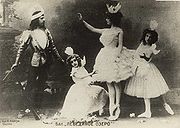
Mikhail Mordkin every bit Prince Siegfried and Adelaide Giuri equally Odette with students every bit the little swans in the Moscow Imperial Bolshoi Theatre's product of the Petipa/Ivanov/Tchaikovsky Swan Lake. 1901
While France was instrumental in early ballet, other countries and cultures soon adopted the fine art form, most notably Russia. Russia has a recognized tradition of ballet, and Russian ballet has had great importance in its country throughout history. Afterwards 1850, ballet began to wane in Paris, simply it flourished in Kingdom of denmark and Russia thanks to masters such as August Bournonville, Jules Perrot, Arthur Saint-Léon, Enrico Cecchetti and Marius Petipa. In the belatedly nineteenth century, orientalism was in faddy. Colonialism brought awareness of Asian and African cultures, but distorted with disinformation and fantasy. The East was frequently perceived as a faraway identify where annihilation was possible, provided it was lavish, exotic and decadent. Petipa appealed to popular taste with The Pharaoh'southward Daughter (1862), and subsequently The Talisman (1889), and La Bayadère (1877). Petipa is best remembered for his collaborations with Tchaikovsky. He used his music for his choreography of The Nutcracker (1892, though this is open to some debate among historians), The Sleeping Dazzler (1890), and the definitive revival of Swan Lake (1895, with Lev Ivanov). These works were all drawn from European sociology.
The female person dancers' classical tutu as information technology is recognized today began to appear at this time. Information technology consisted of a short, stiff brim supported past layers of crinoline or tulle that revealed the acrobatic legwork, combined with a broad gusset that served to preserve modesty.
Argentina [edit]
Ballet companies from Europe began lucrative tours of theatres in North, Fundamental and South America during the mid-19th century. The prestigious Colon Theater in Buenos Aires, Argentina had hosted strange ballet artists on its stage, with touring companies from Europe presenting full ballets as early on as 1867.[40] By the 1880s, the Colon Theater had its own professional person ballet company. It would still be several decades before most countries outside of Europe could claim their ain professional ballet companies, even so.
20th century and modernism [edit]
Russian federation and the Ballets Russes [edit]
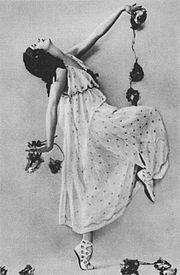
Sergei Diaghilev brought ballet total-circle back to Paris when he opened his company, Ballets Russes. It was made up of dancers from the Russian exile community in Paris subsequently the Revolution.
Diaghilev and composer Igor Stravinsky merged their talents to bring Russian folklore to life in The Firebird and Petrushka choreographed by Fokine. Diaghilev's side by side choreographic commissions went to Nijinsky. His First ballet was 50'apres-midi d'un Faune (Afternoon of a Faun) to music by Debussy. It was notable for its ii dimensional shapes and lack of ballet technique. It caused controversy by depicting the faun rubbing the scarf of one of the maidens on himself, in fake masturbation. The most controversial piece of work of the Ballets Russes however, was The Rite of Spring, choreographed by Nijinsky with music by Stravinsky. The ballet's modern music, dove toed stomping and theme of homo sacrifice shocked audiences so much they rioted.
After the "aureate age" of Petipa, Michel Fokine began his career in St. petersburg simply moved to Paris and worked with Diaghilev and the Ballets Russes.

Russian ballet continued evolution under Soviet dominion. There was little talent left in the country after the Revolution, but it was enough to seed a new generation. After stagnation in the 1920s, past the mid-1930s that new generation of dancers and choreographers appeared on the scene. The technical perfection and precision of dance was promoted (and demanded) by Agrippina Vaganova, who had been taught by Petipa and Cecchetti and headed the Vaganova Ballet University, the school to prepare dancers for the Kirov Ballet in St. Petersburg/Leningrad.
Ballet was pop with the public. Both the Moscow-based Bolshoi and the St. petersburg (and then St. petersburg)-based Kirov ballet companies were active. Ideological pressure forced the cosmos of many socialist realist pieces, most of which fabricated little impression on the public and were removed from the repertoire of both companies later on.
Some pieces of that era, however, were remarkable. The Romeo and Juliet past Prokofiev and Lavrovsky is a masterpiece. The Flames of Paris, while information technology shows all the faults of socialist realist art, pioneered the active utilize of the corps de ballet in the functioning and required stunning virtuosity. The ballet version of the Pushkin verse form, The Fountain of Bakhchisarai with music from Boris Asafiev and choreography by Rostislav Zakharov was as well a striking.
The well-known ballet Cinderella, for which Prokofiev provided the music, is also the product of the Soviet ballet. During the Soviet era, these pieces were mostly unknown outside the Soviet Union and later outside of the Eastern Bloc. However, afterward the collapse of the Soviet Spousal relationship they received more recognition.
The 1999 North American premiere of The Fountain of Bakhchisarai past the Kirov Ballet in New York was an outstanding success, for example. The Soviet era of the Russian Ballet put a lot of accent on technique, virtuosity and strength. It demanded strength usually above the norm of contemporary Western dancers. When watching restored onetime footage, i tin only marvel at the talent of their prima ballerinas such as Galina Ulanova, Natalya Dudinskaya and Maya Plisetskaya and choreographers such every bit Pyotr Gusev.
Russian companies, particularly after Earth War II engaged in multiple tours all over the world that revitalized ballet in the W.
Maiden Tower [41] written by Afrasiyab Badalbeyli is the offset ballet in the Muslim East.[42] [43] [41]
United States [edit]
Following the move of the Ballets Russes to France, ballet began to have a broader influence, particularly in the United States of America.
From Paris, afterwards disagreements with Diaghilev, Fokine went to Sweden and and so the US and settled in New York. Diaghilev believed that traditional ballet offered footling more than prettiness and athletic display. For Fokine that was not enough. In addition to technical virtuosity he demanded drama, expression and historical actuality. The choreographer must research the catamenia and cultural context of the setting and pass up the traditional tutu in favour of accurate flow costuming.
Fokine choreographed Sheherazade and Cleopatra. He besides reworked Petrouchka and The Firebird. I of his most famous works was The Dying Swan, performed past Anna Pavlova. Beyond her talents as a ballerina, Pavlova had the theatrical gifts to fulfill Fokine'south vision of ballet as drama. Legend has information technology that Pavlova identified so much with the swan role that she requested her swan costume from her deathbed.
George Balanchine developed state-of-the-art technique in America past opening a school in New York. He adapted ballet to the new media, movies and television.[44] A prolific worker, Balanchine rechoreographed classics such equally Swan Lake and Sleeping Beauty also as creating new ballets. He produced original interpretations of the dramas of William Shakespeare such equally Romeo and Juliet and A Midsummer Night's Dream, and as well of Franz Léhar's The Merry Widow.
In 1967, Balanchine'southward Jewels broke with the narrative tradition and dramatized a theme rather than a plot. This focus fits with the state-sponsored funding sources in the United States which sought to encourage "liberty and freethinking" in contrast to narrative-driven trip the light fantastic, which was seen equally to be connected too closely with socialism, particularly Soviet communism.[45] Today, partly thanks to Balanchine, ballet is i of the most well-preserved dances in the earth.[ commendation needed ]
Barbara Karinska was a Russian emigree and a skilled seamstress who collaborated with Balanchine to elevate the art of costume pattern from a secondary role to an integral function of a ballet performance. She introduced the bias cut and a simplified classic tutu that allowed the dancer more freedom of move. With meticulous attention to detail, she busy her tutus with beadwork, embroidery, crochet and appliqué.
Neoclassical ballet [edit]

George Balanchine is often considered to accept been the first pioneer of what is at present known as neoclassical ballet, a style of trip the light fantastic between classical ballet and today's contemporary ballet. Tim Scholl, author of From Petipa to Balanchine, considers Balanchine's Apollo (1928) to exist the start neoclassical ballet. Information technology represented a return to form in response to Serge Diaghilev'south abstract ballets. Apollo and other works are still performed today, predominantly by the New York City Ballet. However, other companies are able to pay a fee for performance rights to George Balanchine's works.
Frederick Ashton is another prominent choreographer associated with the neoclassical way. Three of his works have go standard pieces in the international repertoire: Sylvia (1952), Romeo and Juliet (1956), and Ondine (1958), the concluding of which was created every bit a vehicle to showcase Margot Fonteyn.
Contemporary [edit]

One dancer who trained with Balanchine and absorbed much of this neo-classical mode was Mikhail Baryshnikov. Following Baryshnikov's appointment as artistic director of American Ballet Theatre in 1980, he worked with various modern choreographers, nigh notably Twyla Tharp. Tharp choreographed Push Comes To Shove for ABT and Baryshnikov in 1976; in 1986 she created In The Upper Room for her ain company. Both these pieces were considered innovative for their use of distinctly mod movements melded with the use of pointe shoes and classically trained dancers—for their utilise of contemporary ballet.
Tharp also worked with the Joffrey Ballet company, founded in 1957 past Robert Joffrey. She choreographed Deuce Coupe for them in 1973, using pop music and a blend of mod and ballet techniques. The Joffrey Ballet connected to perform numerous contemporary pieces, many choreographed by co-founder Gerald Arpino.
Today there are many contemporary ballet companies and choreographers. These include Madrid Ballet; Royal Ballet of Flanders; Alonzo King and his company, Alonzo Male monarch LINES Ballet; Nacho Duato and Compañia Nacional de Danza; William Forsythe, who has worked extensively with the Frankfurt Ballet and today runs The Forsythe Company; and Jiří Kylián, formerly the artistic manager of the Nederlands Dans Theater. Traditionally "classical" companies, such as the Kirov Ballet and the Paris Opera Ballet, also regularly perform contemporary works.
Development of ballet method [edit]
Several well-known ballet methods are named after their originators. For example, ii prevailing systems from Russia are known as the Vaganova method after Agrippina Vaganova, and the Legat Method, after Nikolai Legat. The Cecchetti method was invented by Italian dancer Enrico Cecchetti (1850–1928), and the Bournonville method, which was invented by Baronial Bournonville (1805–1879), is employed chiefly in Bournonville's ain land of Kingdom of denmark.
See also [edit]
- List of ballets by title
- Ballet music
- History of trip the light fantastic toe
- Black women in ballet
References [edit]
- ^ National Ballet Academy & Trust of India in New Delhi, Republic of india. Retrieved March 29, 2010.
- ^ Chantrell (2002), p. 42.
- ^ Kirstein (1952), p. 4.
- ^ Thoinot Arbeau, _Orchesography_, trans. past Mary Steware Evans, with notes past Julia Sutton (New York: Dover, 1967)
- ^ "BALLET 101: A Consummate Guide to Learning and Loving the Ballet past Robert Greskovic".
- ^ Lee (2002), p. 29.
- ^ «Catherine de' Medici (1519-1589)», article from September 1990, published on "Andros on Ballet" page, on Michael Minn website.
- ^ Vuillier, Gaston (1898). History of Dancing from the Primeval Ages to Our Own Times, pp. 65–69. New York: D. Anderson and Visitor. [Facsimile reprint (2004): Whitefish, Montana: Kessinger Publishing. ISBN 978-0-7661-8166-3.]
- ^ Bland (1976), p. 43.
- ^ Frances A. Yates, _The French Academies of the Sixteenth Century_, second ed. (London: Routledge, 1988)
- ^ Anderson (1992), p. 32.
- ^ Cooper, Elizabeth (2004). "Le Balet Comique de la Reine, 1581: An Analysis". Academy of Washington website.
- ^ Lee (2002), p. 54.
- ^ a b Bland (1976), p. 49.
- ^ "The Social and Political Importance of Dance". www.blakeneymanor.com . Retrieved June 4, 2020.
- ^ Homans, Jennifer. (2010). Apollo's angels : a history of ballet (1st ed.). New York: Random House. p. 52. ISBN978-1-4000-6060-three. OCLC 515405940.
- ^ Homans, Jennifer. (2010). Apollo'due south angels : a history of ballet (1st ed.). New York: Random Business firm. pp. 52, 56–58. ISBN978-1-4000-6060-iii. OCLC 515405940.
- ^ Homans, Jennifer. (2010). Apollo's angels : a history of ballet (1st ed.). New York: Random House. pp. 57–59. ISBN978-1-4000-6060-three. OCLC 515405940.
- ^ a b c d e f Costonis, Maureen Needham (1992). "Beauchamps [Beauchamp] Pierre" in Sadie (1992) ane: 364.
- ^ Homans, Jennifer. (2010). Apollo's angels : a history of ballet (1st ed.). New York: Random Firm. p. 64. ISBN978-i-4000-6060-iii. OCLC 515405940.
- ^ Homans, Jennifer. (2010). Apollo'south angels : a history of ballet (1st ed.). New York: Random Firm. p. 65. ISBN978-1-4000-6060-3. OCLC 515405940.
- ^ Homans, Jennifer. (2010). Apollo's angels : a history of ballet (1st ed.). New York: Random House. pp. 65–66. ISBN978-one-4000-6060-3. OCLC 515405940.
- ^ Homans, Jennifer. (2010). Apollo's angels : a history of ballet (1st ed.). New York: Random House. pp. 66–67. ISBN978-1-4000-6060-iii. OCLC 515405940.
- ^ Homans, Jennifer. (2010). Apollo's angels : a history of ballet (1st ed.). New York: Random House. pp. 67–68. ISBN978-1-4000-6060-iii. OCLC 515405940.
- ^ Homans, Jennifer. (2010). Apollo's angels : a history of ballet (1st ed.). New York: Random Firm. pp. 71–72. ISBN978-one-4000-6060-3. OCLC 515405940.
- ^ Homans, Jennifer. (2010). Apollo's angels : a history of ballet (1st ed.). New York: Random House. pp. 79–85. ISBN978-1-4000-6060-3. OCLC 515405940.
- ^ a b Rosow, Lois (1992). "Lully" in Sadie (1992) 3: 82–89.
- ^ Lee (2002), pp. 72–73.
- ^ a b Lee (2002)., p. 73.
- ^ Homans, Jennifer. (2010). Apollo's angels : a history of ballet (1st ed.). New York: Random Firm. p. 53. ISBN978-1-4000-6060-3. OCLC 515405940.
- ^ Lee (2002), p. 74. Anderson (1992), p. 42.
- ^ a b Pitt, Charles (1992). "Paris" in Sadie (1992) iii: 856.
- ^ a b "Polish National Ballet History". Smooth National Theatre. Retrieved March 15, 2012.
- ^ Kassing, Gayle. History of dance : an interactive arts arroyo. Champaign, IL: Human Kinetics, 2007. Print.
- ^ "The Hungarian National Ballet". Hungarian Country Opera House. Retrieved March xiv, 2012. [ permanent dead link ]
- ^ "MAD. DESARGUS-LEMAIRE ET MDELLE. AMÉLIE GALSTER / dans / le pas de deux polonais". Victoria and Albert Museum. Retrieved March fifteen, 2012.
- ^ Buranbaeva, Oksana; Vanja Mladineo (2011). Culture and Customs of Hungary. ABC-CLIO. p. 172. ISBN978-0-313-38370-0.
- ^ Macaulay, Alastair (September 5, 2012). "Stereotypes in Toeshoes". New York Times. New York, Usa. Retrieved September 5, 2012.
- ^ Bleiberg, Laura (December 9, 2005). "Kiev Ballet cleaves to the classics". Orange County Register . Retrieved March 10, 2012.
- ^ Foster, David William; Melissa Fitch Lockhart; Darrell B. Lockhart (1998). Civilisation and Customs of Argentina. Greenwood Publishing Group. pp. 133. ISBN978-0-313-30319-7.
- ^ a b Музыкальная энциклопедия. Гл. ред. Ю. В. Келдыш. Т 1. А — Гонг. 1072 стб. с илл. М.: Советская энциклопедия, 1973
- ^ Чингиз Абдуллаев: «Вместо того, чтобы отталкивать нас, россиянам надо менять свои взгляды и отношение к народам бывших союзных республик» Archived May 31, 2014, at the Wayback Auto
…первый балет на мусульманском востоке появился у нас.
- ^ Большая Советская Энциклопедия. Гл. ред. А. М. Прохоров, iii-е изд. Т. 1. А — Ангоб. 1969. 608 стр., илл.; 47 л. илл. и карт, 1 отд. л. табл.
- ^ "Archived copy". Archived from the original on November 13, 2007. Retrieved February 9, 2008.
{{cite spider web}}: CS1 maint: archived copy as title (link) George Balanchine - ^ Kiley, Brendan (Feb 7, 2012). "Old Is the New New: The Cold War and Don Quixote at Pacific Northwest Ballet". The Stranger. Seattle, United States. Retrieved February 10, 2012.
Further reading [edit]
- Anderson, Jack (1992). Ballet & Modern Dance: A Concise History (second ed.). Princeton, NJ: Princeton Book Company, Publishers. ISBN0-87127-172-9.
- Andre, Paul; Arkadyev, Five. (1999) Great History of Russian Ballet: Its Art & Choreography (1999).
- Banal, Alexander (1976). A History of Ballet and Dance in the Western Globe . New York: Praeger Publishers. ISBN0-275-53740-4.
- Caddy, Davinia. (2012). The Ballets Russes and Beyond: Music and Dance in Belle-Epoque Paris. Cambridge: Cambridge University Press.
- Cohen, Selma Jeanne, founding editor (1998). International Encyclopedia of Dance. New York: Oxford University Press.
- Cross, Samuel H. (1944) "The Russian Ballet Before Dyagilev." Slavonic and Due east European Review. American Serial 3.4 (1944): 19–49. in JSTOR
- Ezrahi, Christina. (2012) Swans of the Kremlin: Ballet and Power in Soviet Russia (University of Pittsburgh Press); examines the resilience of artistic creativity in a history of the Bolshoi and Marinsky/Kirov ballets
- Franko, Mark (1993). Trip the light fantastic toe as Text: Ideologies of the Baroque Torso. Cambridge: Cambridge University Press.
- Homans, Jennifer, (2010). Apollo's Angels: A History of Ballet. New York: Random House.
- Johnson, Alfred Edwin. (1913) The Russian Ballet (Houghton Mifflin) online
- Kassing, Gayle. (2007). History of trip the light fantastic toe : an interactive arts approach . Champaign, IL: Human Kinetics.
- Lee, Ballad (2002). Ballet In Western Culture: A History of its Origins and Evolution. New York: Routledge. ISBN0-415-94256-Ten.
- Lifar, Serge. (1954). A history of Russian ballet from its origins to the nowadays day (Hutchinson)
- McGowan, Margaret Grand. (1978). 50'fine art du ballet de cour en France, 1581–1643. Paris: Eye National de la Recherche Scientifique.
- Propert, Walter Archibald. (1972) The Russian Ballet in Western Europe, 1909-1920. B. Blom
- Roslavleva, Natalia. (1966). Era of the Russian Ballet, New York: E.P. Dutton & Co., Inc.
- Sadie, Stanley, ed. (1992). The new Grove dictionary of opera (4 volumes). London: Macmillan. ISBN978-one-56159-228-9.
- Surit͡s, Eastward. I͡A, and E. I︠A︡ Surit︠s︡. (1990) Soviet Choreographers in the 1920s (Duke Univ Printing, 1990).
- Wiley, Roland John. (1990) A century of Russian ballet: documents and accounts, 1810-1910 (Oxford University Press)
Source: https://en.wikipedia.org/wiki/History_of_ballet
0 Response to "Name the Highest Form of the Art of Dance Quizlet"
Post a Comment